How does an ACP stripping machine separate aluminum composite panels?
Aluminum Composite Panels (ACP) are everywhere—building facades, signage, interiors, and advertising boards. But once these panels reach the end of their life, they become a recycling headache. Bonded aluminum layers and plastic cores seem impossible to separate efficiently.
That’s where the ACP stripping machine steps in.
If you’ve ever asked, “How does an ACP stripping machine separate aluminum composite panels?”, you’re not alone. This question is one of the most searched topics in the ACP recycling industry—and for good reason. Understanding the separation process can unlock higher aluminum recovery rates, lower operating costs, and faster ROI.
What Is an ACP Stripping Machine?
An ACP stripping machine is an industrial recycling system designed to separate aluminum sheets from the plastic (PE or fire-retardant) core of aluminum composite panels—without shredding the aluminum into low-value scrap.
Unlike traditional shredding or crushing methods, ACP stripping machines focus on clean separation, preserving aluminum quality and maximizing profit.
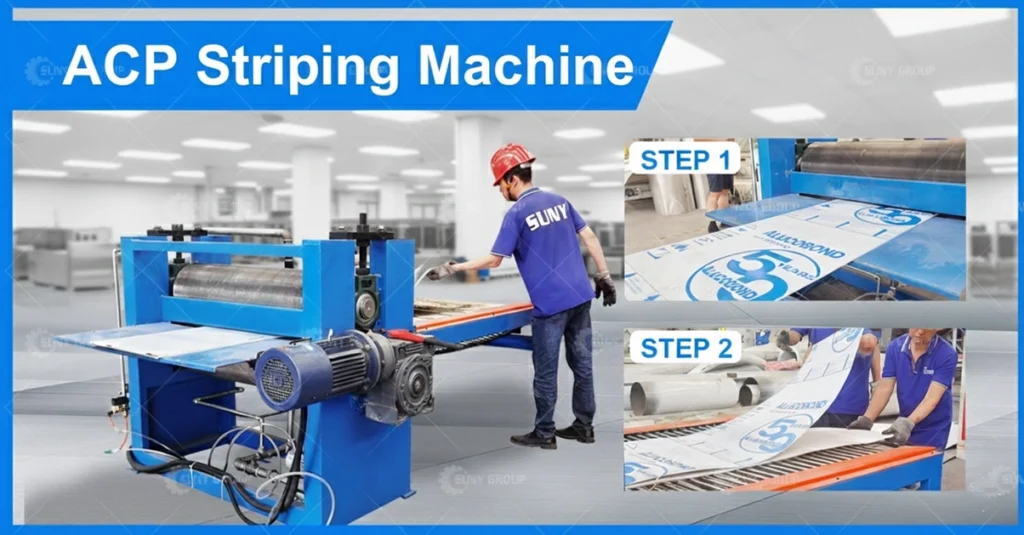
How Does an ACP Stripping Machine Separate Aluminum Composite Panels?
Step 1: Feeding the ACP Sheets
Whole or pre-cut ACP panels are fed into the machine. No complex preprocessing is required, which significantly reduces labor costs.
Step 2: Controlled Heating (Thermal Softening)
The machine applies precisely controlled heat—high enough to soften or decompose the plastic bonding layer, but below aluminum’s melting point (660°C).
Most systems operate between 300–500°C, depending on panel type.
Industry Insight: Studies show that controlled thermal separation can achieve up to 99% aluminum recovery purity.
Step 3: Plastic Core Decomposition
As temperature rises:
PE or FR core loses adhesion
Bonding agents break down
Aluminum sheets naturally loosen
🔥 Key Advantage: No chemical solvents are required—making the process environmentally friendly.
Step 4: Mechanical Stripping Action
Once softened, the machine uses rollers, scrapers, or stripping shafts to physically peel aluminum layers away from the plastic core.
This step is where ACP stripping machines outperform shredders.
✔ Aluminum remains intact sheets or large flakes
✔ Plastic separates cleanly
✔ Minimal aluminum loss
Frequently Asked Questions About ACP Stripping Machines
1. Does the machine work on fire-retardant (FR) ACP panels?
Yes. Advanced ACP stripping machines are designed to handle both PE and FR cores, with adjustable temperature settings.
2. Is the process environmentally friendly?
Absolutely. Most ACP stripping systems:
- Use no chemicals
- Produce minimal emissions
- Allow plastic residue to be reused as fuel or filler material
3. What capacity can an ACP stripping machine handle?
Depending on model:
- Small systems: 300–500 kg/hour
- Industrial lines: 1–3 tons/hour
Choosing the right capacity is key to ROI.
So, how does an ACP stripping machine separate aluminum composite panels?
By combining controlled heating, intelligent mechanical stripping, and clean material separation, it achieves what shredders and crushers simply can’t—maximum aluminum recovery with minimal loss.
If you’re serious about ACP recycling, profitability, and sustainability, ACP stripping technology isn’t optional anymore—it’s essential.