Waste Aluminum-Plastic Separation and Recycling Production Line
Waste aluminum-plastic composite materials are widely used in construction, pharmaceutical packaging, food packaging, consumer goods, cables, and daily necessities. Aluminum-plastic panels, blister packs, toothpaste tubes, bottle caps, laminated films, and composite packaging all contain valuable recyclable materials—but their tightly bonded structure makes disposal and recycling challenging.
A waste aluminum-plastic separation and recycling production line is designed to process these composite materials efficiently. Through crushing, grinding, air separation, electrostatic separation, and dust collection, the line separates aluminum from plastic and converts waste into reusable secondary raw materials.
What Is an Aluminum-Plastic Separation and Recycling Line?
An aluminum-plastic recycling production line is a mechanical recycling system that separates metal and non-metal fractions from aluminum-plastic composite waste. Instead of sending valuable materials to landfill or incineration, recyclers can recover aluminum granules and plastic fractions for further processing or resale.
The system is suitable for a wide range of materials, including:
- Aluminum composite panels (ACP)
- Pharmaceutical blister packs and medicine boards
- Aluminum-plastic films and laminated packaging
- Food bags, milk bags, and beverage packaging
- Toothpaste tubes and aluminum-plastic tubes
- Aluminum-plastic caps and seals
- Aluminum foil composite materials
- Other mixed metal-plastic scrap
By recovering both aluminum and plastic, recycling companies can reduce raw-material waste while creating a more profitable and sustainable operation.
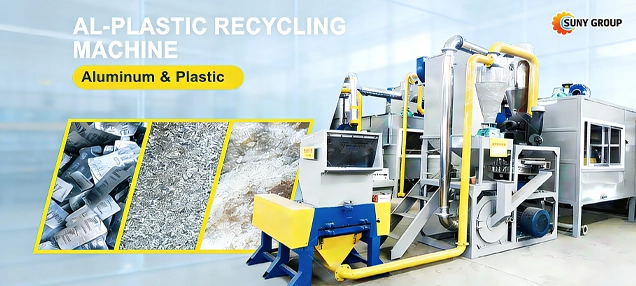
How Does the Aluminum-Plastic Recycling Process Work?
A complete waste aluminum-plastic separation and recycling production line usually includes several coordinated processing stages.
1. Feeding and Pre-Treatment
Waste materials are fed into the production line by conveyor. Depending on the feedstock, oversized materials may first be cut or shredded to a manageable size. Stable and uniform feeding helps improve separation performance and protects downstream equipment.
2. Crushing and Size Reduction
The material enters a crusher or shredder, where it is broken into smaller pieces. Further grinding reduces the particles to a suitable size for effective liberation of aluminum and plastic.
The purpose of size reduction is not simply to make the material smaller. It is to break the bond between different material layers so that the metal and plastic can be separated more accurately in the next stage.
3. Air Separation
After crushing and grinding, airflow separation removes lightweight dust, fibers, film fragments, and other low-density impurities. This stage improves material purity and helps maintain stable performance in the separation system.
4. Electrostatic Separation
Electrostatic separation is one of the key processes in an aluminum-plastic recycling line. It uses the different electrical properties of conductive aluminum and non-conductive plastic to separate the mixed material.
The aluminum fraction is collected separately from the plastic fraction, enabling recyclers to obtain cleaner recovered materials with higher recycling value.
5. Dust Collection and Environmental Control
Dust management is essential in mechanical recycling operations. A well-designed production line can be equipped with a multi-stage dust collection system, such as cyclone separation, bag filtration, and air purification.
This helps maintain a cleaner working environment, reduces dust emissions, and supports safer daily operation.
Key Advantages of a Waste Aluminum-Plastic Recycling Production Line
High-value material recovery
Aluminum and plastic can both be recovered from composite waste. This creates more value than simple disposal and supports the circular use of resources.
Broad material adaptability
The line can be configured to handle many types of aluminum-plastic waste, including rigid panels, flexible packaging, pharmaceutical waste, and composite tubes.
Automated operation
Conveyors, crushers, separators, and dust collectors can work together as an integrated system. Automation reduces manual handling and helps improve production efficiency.
Cleaner recycling process
With effective dust collection and enclosed material handling, the production line can minimize dust leakage during crushing and separation.
Customizable capacity
Recycling plants have different feedstocks and output requirements. Equipment capacity and configuration can be customized based on material type, particle size, production volume, and site conditions.
Why Recycle Aluminum-Plastic Composite Waste?
Aluminum-plastic waste is often difficult to recycle through conventional methods because aluminum and plastic are bonded together. However, both materials have practical recycling value when properly separated.
Recovered aluminum can be used as a secondary metal resource, while recovered plastic may be processed into recycled plastic products or used as feedstock for further recycling. This helps reduce dependence on virgin raw materials and lowers the environmental burden associated with waste disposal.
For recycling companies, waste management facilities, and industrial material processors, investing in an aluminum-plastic separation system can turn challenging composite waste into marketable recycled materials.
Choose the Right Aluminum-Plastic Recycling Equipment
When selecting a waste aluminum-plastic separation and recycling production line, consider the following factors:
- Type and composition of incoming waste
- Required processing capacity per hour
- Target purity of aluminum and plastic output
- Required particle size after crushing
- Available installation space
- Dust control and environmental requirements
- Automation level and labor requirements
A suitable equipment supplier should be able to evaluate your material samples and recommend a tailored recycling solution.
Conclusion
A waste aluminum-plastic separation and recycling production line offers an efficient way to process composite waste and recover valuable aluminum and plastic resources. By combining crushing, grinding, air separation, electrostatic sorting, and dust collection, the system supports cleaner recycling, improved material recovery, and stronger economic returns.
If you are looking for an aluminum-plastic recycling solution for ACP panels, blister packs, composite packaging, or other metal-plastic waste, a customized recycling production line can help transform waste into reusable value.