Aluminum-Plastic Waste Separation and Recycling: Complete Process & Equipment
Aluminum-plastic waste is widely generated from pharmaceutical blister packs, food packaging bags, aluminum-plastic panels, aluminum-plastic tubes, toothpaste packaging, bottle seals, waste wires, cables, and circuit boards. Because aluminum and plastic are often bonded together, separating them efficiently is an important step in recovering these valuable materials.
An aluminum plastic separator uses mechanical crushing and high-voltage electrostatic separation to separate aluminum from plastic. The process is designed as a dry separation method without organic chemical separation liquids.
aluminum-plastic recycling equipment is designed for different types of aluminum-plastic composite waste and can achieve a published separation purity of up to 99.9%.
Aluminum Plastic Separation Process
The aluminum-plastic recycling process mainly includes crushing, grinding, electrostatic separation, and dust removal.
1. Crushing and Grinding
The aluminum-plastic waste is first processed by a special crusher. The equipment uses specially designed blades and a stepped cutting structure to improve cutting efficiency and material processing.
The crusher can process various materials, including plastic sheets, plastic films, aluminum profiles, pipes, fittings, and other block-shaped materials.
In our separation process, aluminum-plastic materials can be shredded to a particle size of less than 1.5 mm. This facilitates the separation of aluminum and plastic components prior to electrostatic sorting.
2. High-Voltage Electrostatic Separation
After crushing and grinding, the material enters the high-voltage electrostatic separator.
The separator uses the different electrical properties of metals and plastics to separate the materials. It can process aluminum-plastic mixtures as well as other metal-plastic materials.
According to the published specifications, the equipment has a capacity of 1–10 tons/day, depending on the quality and volume ratio of the raw materials. The screening purity can reach 99.9%, while the residue after electrostatic screening can be less than 0.1%.
3. Dust Removal
Dust removal is incorporated into the recycling system to control dust generated during crushing and grinding.
The published system uses a three-stage dust removal configuration:
- Cyclone dust removal
- Bag dust collector
- Air purifier dust removal
This configuration is designed to reduce dust during the recycling process.
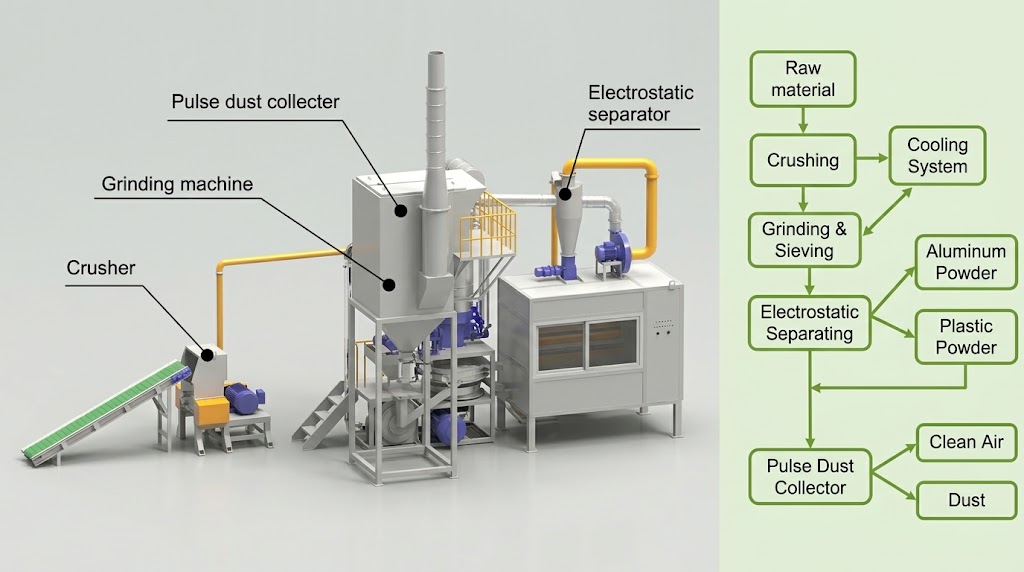
Aluminum Plastic Separation Process
Aluminum Plastic Recycling Machine Parameters
The main technical parameters:
| Parameter | Aluminum-Plastic Crusher | High-Voltage Electrostatic Separator |
|---|---|---|
| Main Function | Crushing and grinding | Aluminum-plastic separation |
| Processing Capacity | 180–285 kg/h | 1–10 tons/day |
| Main Power | 37 kW | 380V AC / 2A / 50Hz |
| Cutterhead | 1 pc | — |
| Cutterhead Diameter | 483 ± 1 mm | — |
| Blades | 24 pcs | — |
| Centrifugal Fan | 3 kW | — |
| Air Shutoff Device | 0.75 kW motor | — |
| Equipment Size | 5900 × 1450 × 2900 mm | 1.7 × 1.5 × 2.5 m |
| Net Weight | 1205 kg | — |
| Separation Purity | — | Up to 99.9% |
The crusher capacity is specified for PVC 20–100 mesh, while the electrostatic separator capacity depends on the quality and volume ratio of different raw materials. Therefore, these two figures represent different processing stages and should not be treated as the capacity of a complete line.
What Materials Can an Aluminum Plastic Separator Process?
The aluminum-plastic separation equipment can be used for a variety of metal-plastic mixtures.
Pharmaceutical Blister Packs
Applications include aluminum-plastic pharmaceutical blister packs. Following crushing and pre-treatment processes, the equipment separates the aluminum and plastic components.
Aluminum-Plastic Panels
Aluminum-plastic panel scraps generated during manufacturing and processing can be crushed and separated to recover aluminum and plastic.
Aluminum-Plastic Tubes
Aluminum-plastic tubes are another application of the electrostatic separation system. The process can separate the metal and plastic components after suitable size reduction.
Food Packaging and Flexible Films
The equipment can process various aluminum-plastic composite films, including food packaging bags and similar flexible packaging materials.
Wires, Cables and Circuit Boards
The high-voltage electrostatic separator can also be used for selected mixtures of metals and plastics, including waste wires, cables, and waste printed circuit boards.
Advantages of Aluminum Plastic Separation Equipment
Dry Separation Technology
The high-voltage electrostatic separator uses a dry mechanical separation method and does not require organic chemical separation liquids.
High Separation Purity
The published specifications state that separation purity can reach 99.9%, with residue after electrostatic screening of less than 0.1% under the described conditions.
Automated Processing
The recycling equipment can combine multiple machines with automatic material transportation, reducing manual handling between processing stages.
Integrated Dust Removal
The three-stage dust removal system combines cyclone dust removal, bag filtration, and air purification to help control dust generated during processing.
Aluminum and Plastic Recovery
The main purpose of the process is to separate aluminum and plastic into individual material streams. The separated materials can then be collected for further recycling and utilization.
How to Choose an Aluminum Plastic Separator
Before selecting an aluminum plastic recycling machine, the feed material should be evaluated carefully.
Feed Material
Provide information about the material, such as:
- Pharmaceutical blister packs
- Aluminum-plastic films
- Food packaging
- Aluminum-plastic panels
- Aluminum-plastic tubes
- Toothpaste packaging
- Bottle seals
- Wires and cables
- Circuit boards
Required Capacity
The required processing capacity is another important consideration. The published crusher capacity is 180–285 kg/h, while the electrostatic separator is rated at 1–10 tons/day.
Because different materials have different physical characteristics, the final equipment configuration should be selected according to the actual feedstock and required production capacity.
Required Separation Purity
The high-voltage electrostatic separator has a published maximum separation purity of 99.9%. Actual results can depend on the composition, particle size, and characteristics of the material being processed.
Frequently Asked Questions
What is an aluminum plastic separator?
An aluminum plastic separator is recycling equipment used to separate aluminum and plastic from composite or mixed waste. The system combines crushing, grinding, and high-voltage electrostatic separation.
How does an aluminum plastic separator work?
The material is first crushed and ground to improve the liberation of aluminum and plastic. The processed particles are then separated using high-voltage electrostatic technology.
What is the capacity of the aluminum-plastic crusher?
The published capacity is 180–285 kg/h for PVC material at 20–100 mesh.
What is the capacity of the electrostatic separator?
The published capacity is 1–10 tons/day, depending on the quality and volume ratio of different raw materials.
What separation purity can the machine achieve?
The published separation purity can reach 99.9%, with residue after electrostatic screening stated as less than 0.1%.
What is the power of the aluminum-plastic crusher?
The main motor rated power is 37 kW. The equipment also uses a 3 kW centrifugal fan and a 0.75 kW air shutoff motor.
What is the size of the electrostatic separator?
The published dimensions are 1.7 m long × 1.5 m wide × 2.5 m high.
Does the process require chemical separation liquids?
The published high-voltage electrostatic separation process is described as a dry separation method without organic chemical separation liquids.
Conclusion
An aluminum plastic separator provides a dry recycling solution for separating aluminum and plastic from composite waste. The process combines mechanical crushing and grinding with high-voltage electrostatic separation.
the aluminum-plastic crusher has a 37 kW main motor and a processing capacity of 180–285 kg/h, while the high-voltage electrostatic separator has a capacity of 1–10 tons/day and a published separation purity of up to 99.9%.
The equipment can be applied to pharmaceutical blister packs, aluminum-plastic panels, tubes, food packaging films, wires, cables, circuit boards, and other suitable metal-plastic mixtures.
For the best equipment configuration, the actual raw material, required capacity, and target separation purity should be evaluated before selecting the complete aluminum-plastic recycling system.