Tetra Pak Recycling Machine for Aluminum-Plastic Separation and Material Recovery
Tetra Pak cartons are widely used for milk, juice, beverages, and other liquid food products because their multilayer structure provides excellent protection against light, oxygen, moisture, and contamination. However, this composite structure also makes recycling more challenging than processing ordinary paper or plastic packaging.
A Tetra Pak recycling machine provides an efficient solution for recovering valuable materials from discarded cartons. By using crushing, grinding, screening, and separation technologies, the recycling process can separate aluminum and plastic from other components and turn waste packaging into reusable materials.
For recycling companies, waste management plants, and material recovery facilities, a properly configured Tetra Pak recycling machine can help improve material recovery, reduce waste disposal, and create additional value from discarded packaging.
What Is a Tetra Pak Recycling Machine?
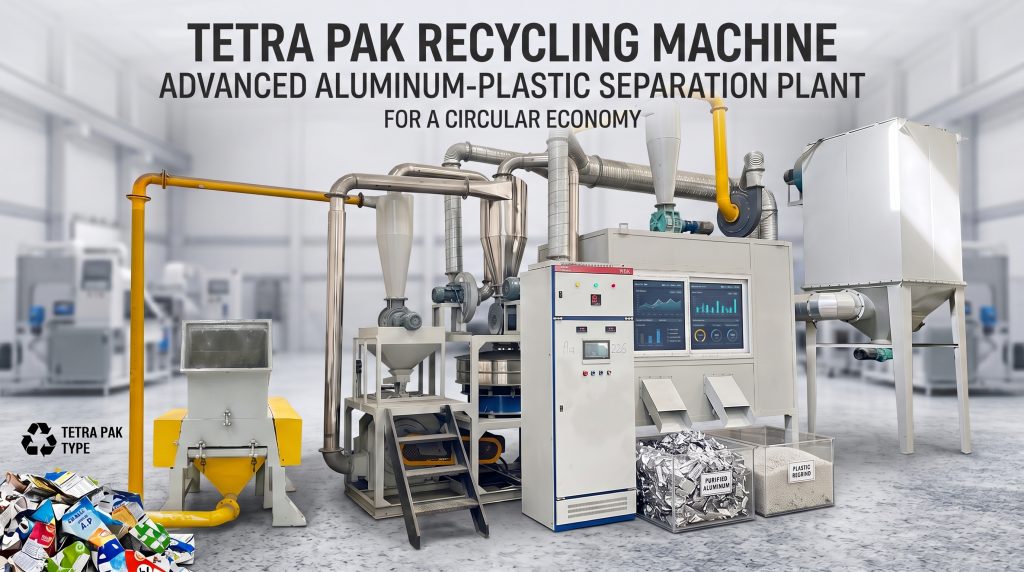
A Tetra Pak recycling machine is specialized recycling equipment designed to process waste Tetra Pak cartons and other paper-plastic-aluminum composite packaging.
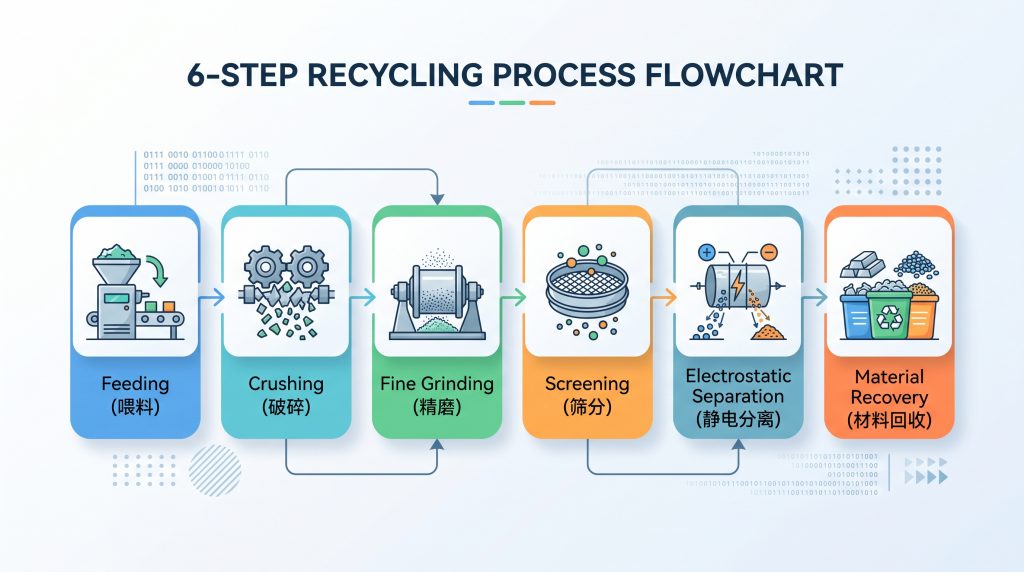
Depending on the raw material and the required final products, the recycling system can use different separation technologies. For aluminum-plastic separation, SUNY GROUP uses a combination of mechanical size reduction, fine grinding, screening, and electrostatic separation.
The basic process can be summarized as:
For Tetra Pak cartons, the recycling process may also include fiber recovery. During paper-based carton recycling, the paper fibers can be separated from the plastic and aluminum components, allowing the recovered fiber and polyAl materials to be processed separately.
Why Is Tetra Pak Recycling Challenging?
Tetra Pak cartons are composite packaging materials rather than single-material products. A typical aseptic carton is made from approximately 70% paperboard, 25% plastic, and 5% aluminum. Each material has a specific function: paperboard provides strength and structure, polymers help prevent moisture from entering, while the thin aluminum layer protects the contents from light and oxygen. For more information about carton materials and their functions, see Tetra Pak’s official packaging information. Tetra Pak’s official packaging information
This multilayer structure provides effective product protection, but it also makes recycling more complex than processing single-material packaging. During recycling, the different material components need to be separated or processed through suitable recovery methods.
There are several challenges when recycling Tetra Pak packaging:
1. Multiple Materials Are Bonded Together
Paper, plastic, and aluminum are combined into a multilayer structure. Therefore, simply shredding the cartons does not produce clean individual materials.
2. Aluminum and Plastic Are Difficult to Sort Mechanically
After crushing and grinding, aluminum and plastic particles may remain mixed together. A suitable separation technology is therefore required to achieve a higher level of material purity.
3. Particle Size Affects Separation Efficiency
If the material is too large, the different components may not be sufficiently liberated. If it is excessively fine, dust generation and material loss can increase.
For this reason, crushing, grinding, and screening need to be properly matched to the characteristics of the incoming Tetra Pak waste.
How Does a Tetra Pak Recycling Machine Work?
The exact configuration depends on the raw material and the required output. For aluminum-plastic separation, the main process can include the following stages.
Step 1: Material Feeding
Waste Tetra Pak cartons are continuously fed into the recycling system through a conveyor or feeding device.
A stable feeding system helps maintain a consistent material flow and improves the overall operating stability of the production line.
Step 2: Coarse Crushing
The first crushing stage reduces the size of the incoming packaging material.
According to the SUNY GROUP process, the material can be initially crushed into smaller flakes before entering the fine grinding stage. Proper particle size reduction helps expose the different material components and prepares the waste for further separation.
Step 3: Fine Grinding
After coarse crushing, the material enters a fine grinding system.
SUNY GROUP’s aluminum-plastic separation technology uses water-cooled or air-cooled turbine mills depending on the application. Cooling helps control material temperature during high-speed grinding and supports more stable processing.
The objective is to produce a sufficiently fine and uniform mixture of aluminum and plastic particles.
Step 4: Screening
The ground material passes through a screening system.
A rotary vibrating screen can be used to classify particles according to size. Oversized or unsuitable material can be returned to the grinding system for further processing.
This closed-loop design helps improve the consistency of the material entering the separation stage.
Step 5: Electrostatic Separation
Electrostatic separation is one of the key technologies used for aluminum-plastic separation.
Aluminum is electrically conductive, while plastic has different electrical properties. By exploiting these differences in an electrostatic field, the separator can separate aluminum particles from plastic particles.
This process is particularly useful for composite materials where mechanical separation alone cannot achieve the required material purity.
Step 6: Material Collection
After separation, the recovered materials are collected separately.
Depending on the system configuration and feedstock, the output may include aluminum-containing material, plastic material, or other recovered fractions.
These materials can then be further processed or sold as secondary raw materials.
Main Equipment in a Tetra Pak Recycling Line
A complete Tetra Pak recycling machine is normally composed of several interconnected units rather than a single machine.
Typical equipment may include:
- Feeding conveyor
- Primary crusher
- Fine grinder or turbine mill
- Rotary vibrating screen
- Electrostatic separator
- Dust collection system
- Material conveyors
- Finished-material collection system
The equipment configuration should be customized according to the type of Tetra Pak waste, required capacity, target output, and required material purity.
For projects focused specifically on recovering paper fibers from Tetra Pak cartons, a different process may be required. Hydraulic pulping, screening, dewatering, and pulp treatment can be incorporated to recover usable paper fiber before further processing of the plastic and aluminum fraction.
What Materials Can a Tetra Pak Recycling Machine Process?
Although Tetra Pak cartons are a major application, aluminum-plastic separation technology can also be used for other composite materials.
Typical applications include:
- Tetra Pak cartons
- Milk and beverage cartons
- Aluminum-plastic packaging
- Pharmaceutical blister packs
- Aluminum-plastic tubes
- Aluminum-plastic sheets
- Composite packaging waste
- Aluminum foil and plastic composites
The suitable process depends on the physical and electrical characteristics of the material. Therefore, a material test is recommended before selecting the final equipment configuration.
Advantages of Tetra Pak Aluminum-Plastic Separation
A properly designed recycling system can provide several practical advantages.
High Separation Efficiency
The combination of mechanical processing and electrostatic separation allows aluminum and plastic to be separated more effectively than conventional mechanical sorting alone.
Dry Physical Separation
For aluminum-plastic separation applications, the process can use dry physical separation technology. This helps avoid wastewater generation associated with wet processing.
Low Material Loss
The grinding and screening stages can be configured as a closed-loop process, allowing oversized material to return for additional processing.
Flexible Applications
The same separation technology can be adapted to various aluminum-plastic composite materials, including Tetra Pak packaging, pharmaceutical blister packs, and aluminum-plastic tubes.
Automated Operation
A complete production line can integrate conveyors, crushing, grinding, screening, separation, and dust collection systems to reduce manual handling and support continuous operation.
Tetra Pak Recycling Machine for Different Recovery Goals
Not every Tetra Pak recycling project requires the same process.
If the primary goal is paper fiber recovery, a hydraulic pulping and screening process may be more appropriate.
If the goal is aluminum and plastic separation, mechanical crushing, grinding, screening, and electrostatic separation can be considered.
For projects requiring multiple recovered materials, a customized combination of paper fiber separation and aluminum-plastic processing may provide a more suitable solution.
This is why the selection of a Tetra Pak recycling machine should be based on the actual composition of the waste and the required final products rather than using a standard equipment configuration for every project.
How to Choose the Right Tetra Pak Recycling Machine?
Before purchasing recycling equipment, consider the following factors:
1. Raw Material
Provide information about the type of Tetra Pak waste, including milk cartons, beverage cartons, production scraps, or mixed composite packaging.
2. Processing Capacity
The required capacity directly affects the crusher, grinder, separator, conveyors, and other equipment specifications.
3. Final Products
Clearly define whether you want to recover paper pulp, aluminum, plastic, or a combination of these materials.
4. Material Purity
Higher requirements for final material purity may require additional screening or separation stages.
5. Plant Layout
The available workshop space, material flow, electrical supply, and dust-control requirements should all be considered when designing the recycling line.
6. Material Testing
Different composite packaging materials can behave differently during grinding and separation. A sample test can help determine the appropriate equipment configuration before a complete production line is manufactured.
Why Choose SUNY GROUP for Tetra Pak Recycling Equipment?
SUNY GROUP develops and manufactures recycling equipment for aluminum-plastic composites, Tetra Pak packaging, and other solid waste applications.
Our solutions can be customized according to the customer’s raw materials, processing capacity, material composition, and recovery requirements.
For aluminum-plastic separation, the equipment can integrate crushing, grinding, screening, electrostatic separation, and dust collection into a continuous recycling system.
SUNY GROUP also provides solutions for other recycling applications, including e-waste recycling, lithium battery recycling, solar panel recycling, cable recycling, and aluminum-plastic recycling.
Conclusion
A Tetra Pak recycling machine can transform difficult-to-process composite packaging waste into recoverable resources. Through a combination of crushing, fine grinding, screening, and electrostatic separation, aluminum and plastic can be separated more effectively for further processing and reuse.
For projects that also require paper fiber recovery, the recycling system can be designed with additional pulping, screening, and dewatering equipment.
The most suitable solution depends on the composition of the Tetra Pak waste, required capacity, target material purity, and final products. Before purchasing equipment, it is recommended to conduct a material test and confirm the complete process configuration.
If you are planning a Tetra Pak recycling plant or need an aluminum-plastic separation machine, contact SUNY GROUP with your raw material, required capacity, and expected recovered products. Our engineers can recommend a suitable recycling solution based on your specific requirements.